STEM, STEAM, Tinkering Labs, Maker Spaces, and Design Thinking: What Schools Need to Know
The Rise of Innovation-Focused Learning Spaces
Today, every progressive school and educator either already has a STEM Lab, Tinkering Space (Maker Space), or a Design Studio—or is actively planning to establish one. These innovation-focused learning environments have become a hallmark of modern education, representing a shift away from rote memorization and toward creativity, critical thinking, and problem-solving.
As awareness grows among school leaders regarding the importance of experiential and Project-Based Learning (PBL), and with increasing support from government initiatives promoting innovation and tinkering, Indian K–12 education is undergoing a significant transformation toward 21st-century learning.
The Growing Confusion Around STEM and STEAM
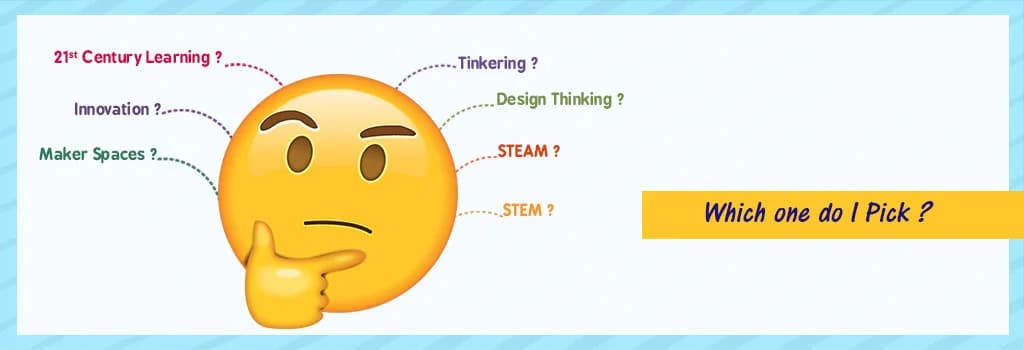
With growing popularity comes a fair amount of confusion.
Schools often ask:
- Is STEM better than STEAM?
- Does purchasing robotics kits automatically mean STEM education is being implemented?
- How can schools measure the impact of tinkering programs beyond student engagement?
- Should STEM activities be connected to the curriculum?
- Is Design Thinking the missing piece in innovation education?
These are important questions that deserve careful consideration.
Beyond Kits and Technology
The debate between STEM and STEAM is largely semantic unless the conversation focuses on learning outcomes.
STEM and STEAM activities are not goals in themselves—they are tools that support larger educational objectives. Even the most advanced robotics, IoT, coding, or engineering kits will have limited impact if they are not accompanied by thoughtfully designed projects and learning experiences.
Technology alone does not create innovators. The quality of the learning process matters far more than the tools being used.
Building a Sustainable Culture of Tinkering
Tinkering Labs and Maker Spaces symbolize a shift toward hands-on learning before minds-on learning. However, creating a sustainable culture of innovation requires much more than setting up a dedicated physical space.
Success depends on developing an ecosystem where:
- Teachers are empowered and trained.
- Parents understand and support experiential learning.
- School systems encourage creativity and experimentation.
- Students gradually transition from guided activities to open-ended challenges.
When implemented effectively, this progression enables students to derive maximum value from Project-Based Learning (PBL) and STEM/STEAM programs.
The Critical Role of Design Thinking
Design Thinking provides a structured framework that helps students connect classroom concepts with real-world challenges.
Through the Design Thinking process, students learn to:
- Empathize with users and stakeholders.
- Define meaningful problems.
- Generate creative ideas.
- Build prototypes and test solutions.
- Reflect, iterate, and improve.
This approach fosters innovation while developing essential skills such as collaboration, communication, critical thinking, and problem-solving.
For Design Thinking to be successful, teachers must receive adequate training and ongoing support so they can effectively facilitate student learning experiences.
A Shared Goal: Preparing Inspired Innovators
Whether schools choose STEM Labs, STEAM Labs, Tinkering Spaces, Maker Spaces, or Design Studios, these approaches ultimately serve the same purpose.
Their collective goal is to help students develop:
- Critical thinking skills
- Creativity and innovation
- Digital literacy
- Collaboration and communication skills
- Problem-solving abilities
- Real-world application of knowledge
Together, these learning environments prepare students for higher education, future careers, and the rapidly evolving demands of the modern world.
The true measure of success is not the technology inside the lab, but the thinking, creativity, and innovation it inspires in students.
About the Author
Venkatesh Datla
Co-founder, Creya Learning & Research
Venkatesh Datla is a Co-founder of Creya Learning, a pioneer in integrative STEM learning and Design Thinking programs for developing 21st-century skills in the Indian K–12 education sector. He is a passionate advocate of the "Thinking Through Tinkering" movement and believes that empathy is a critical foundation for meaningful learning, innovation, and long-term student success.